11.01.11

THUNDERTOME {NOMINALLY-BLOODLESS BOOK CHAT EDITION}: ROUND I

PERFORMER: the magicians (lev grossman)
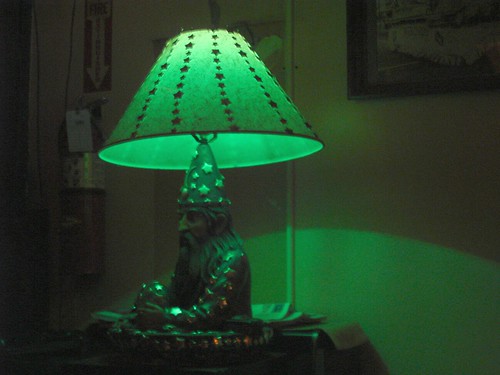
lamps i appreciate, 1

here be spoilers; if you haven't read the book and plan to do so at some point, please enjoy this wizard lamp and avert your eyes from the rest of the post. temporarily-actual reading group discussion questions - also containing spoilers - are at its conclusion.

lev grossman went to harvard and yale; he's a prolific tech journalist, and he's time's book reviewer. each of those points is in his bio, but they don't really need to be; the magicians is precisely the book you'd expect from a guy who's done time at elite schools, chewed on a bunch of cables, and read a lot of books. that's both a good thing and a bad thing, i think; some of its biggest strengths (the pitch-perfect tone of the school scenes, the elegant logic of the magical phrasing the students learn in antarctica and the eerie interdimensional neitherlands, the feel of all the literature that gave rise to this literature) share genes with its faults (quentin is the sort of overeducated douchebag i couldn't wait to get away from after college, so several hundred pages of him can be rough, and grossman's fluency in all things sci-fi and fantasy can have a too-many-chefs effect that's fatal to emotional connection with his story).

grossman's hero, quentin "brooding in brooklyn" coldwater, is bizarro harry potter, at least at first: much to his horror, his parents have provided him with a stable and loving home, he has a pair of reliable friends (who have done him the terrible injustice of dating each other), and he's on track to trundle off to princeton after he winds up his reign as the (academic) king of high school. all of this is terrifically unsatisfying, and he pines for the narnia-esque idylls of christopher plover's mythical kingdom of fillory, where there are two aslans (the rams ember and umber), one gets about with the help of the cozy horse, a living, infantilizing monorail (for my money, the cozy horse is one of grossman's best jokes), and
things mattered in a way they didn't in this world. In Fillory you felt the appropriate emotions when things happened. Happiness was a real, actual, achievable possibility. It came when you called. Or no, it never left you in the first place.
this third-person limited narration (quentin isn't the speaker, but we experience just about everything from his perspective) is pretty challenging for the reader: we have to endure quentin's bottomless self-pity, and we have to work around his world-swallowing self-interest to pick up information about characters and plot points which don't hold his attention. we're also stuck with his emotional vocabulary, which is - high-school boyfriends, i salute you - not the most mature.
Sometimes he burst out laughing out of nowhere, for no reason. He was experimenting cautiously with the idea of being happy, dipping an uncertain toe into those intoxicatingly carbonated waters. It wasn't something he'd had much practice at. It was just too fucking funny. He was going to learn magic! He was either the greatest genius of all time or the biggest idiot. But at least he was actually curious about what was going to happen to him next. For the first time in he didn't know how long he was actually following the action with interest. In Brooklyn reality had been empty and meaningless--whatever inferior stuff it was made of, meaning had refused to adhere to it. Brakebills was different.
on most days i would make much of that take on brooklyn, but in the spirit of the nominally-bloodless book chat, i'll refrain; that's emotional maturity, you see. to be fair, not all of the focus on quentin is problematic; though the life of his mind is the only life he's got, the magicians fetishizes wizard school far less than the harry potter books do. i didn't realize how refreshing it was to gloss over huge areas of quentin's education (sometimes literally, as in when he tests out of his first year) without having to page through baroque descriptions of each teacher, class, spell, and magical-slapstick episode he encounters until grossman pointed it out to me; at some point near the end of the brakebills section of the book, someone mentions how silly it is that each of the twenty-odd parts of the students' desks has a special name (a simple, effective reminder that the school isn't the end or even the bulk of the story here).

the educational vignettes we do get are well-chosen; i loved the sequence in which the students turned into geese and flew to antarctica, and i thought the instruction sequences there were terribly clever. it's no accident that mayakovsky (a fine name) speaks russian; russian grammar is as subjective as the magic the kids are learning (with variations for everything from time to location to the emotional state of the spellcaster), with prefixes and suffixes of each tense so specific to what surrounds it that you can scramble the words of your sentence any which-way and they'll mean the same thing. well done there, grossman; those drills and the marvelous end-of-term trip to the south pole were worth the price of admission on their own.

lest we get too caught up in grossman's creations, he sprinkles a glib bit of meta over the top of quentin's return to brakebills: "wizard needs food badly," his friend josh* notes. i can't decide whether the gauntlet reference pleases or appalls me; as when joss whedon & co dropped a homestar runner reference into the buffy the vampire slayer finale and burninated giles, i enjoyed feeling that the writer(s) and i were working with the same cultural tool box...and felt a bit dirty at the same time. in this case, do present-day college students really joke about twenty-six-year-old atari games? am i underestimating the next generation's nerdery? am i old enough to call present-day college students 'the next generation'? let's move on.

speaking of grossman's tool box, harry potter references aside, there's a lot of the early 20th century in his particular strain of fantasy, and i think it suits him. the beast's appearance in the classroom was equal parts h.p. lovecraft (the explanatory speech the headmaster gives about how beings from other worlds visit ours is boss) and magritte; its extra fingers** and the tree branch in front of its face were terrifying, and just right. the girl in the brakebills fountain who showed the unfortunate emily greenstreet how to remake her face was also quite frightening; her malevolence set us up nicely for the vacant, escherrific spookiness of the neitherlands. somehow those interstices felt more real to me than either the cringe-inducing, post-graduation scenes in new york city (though, to be fair, some twentysomethings do end up in cringe-inducing scenes when in new york city) or the scenes in fillory itself.

on those scenes in fillory itself: the conclusion of michael agger's new york times review kept coming back to me as i was thinking about what i wanted to say about the magicians.
Perhaps a fantasy novel meant for adults can’t help being a strange mess of effects. It’s similar to inviting everyone to a rave for your 40th-birthday party. Sounds like fun, but aren’t we a little old for this?
it's an easy observation to make about genre fiction, and - when one considers spectacular works like buffy the vampire slayer and philip pullman's his dark materials trilogy - easy to swat down. the magicians provides both the sugar rush of shallow fantasy and the deep, soulful twang of shrewd allegory, and they're both all over the ember's tomb sequence (a mishmash of grossman's worst and best ideas). poorly-blocked battles lifted from early-nineties role-playing games (a bee, a house cat, and a giant, burning naked guy! better have my mage cast an elemental shield around the party and swap in the warrior's poisoned gauntlets) and an ill-advised scarface reference at the book's emotional climax? check and check. a heartbreaking sacrifice which highlights the fact that there's no answer here to the "what's magic for?" question,*** and a chilling demonstration of what happens when you can't say goodbye to the cozy horse?**** check and check. the magicians is, unquestionably, a strange mess of effects - but i can't imagine being too old for it.

hey, you made it to the end of my introduction to the book chat! butterbeer for everyone, or regular beer, or whiskey, if you're gluten-intolerant. feel free to tell me i'm dead wrong, or to ignore me and skip to the points below, or to ignore the points below and skip to your own take on the magicians in the comments. i'm just glad you're here.


temporarily-actual reading group discussion questions: extra-long edition

01 do you think quentin's unlikable on purpose? or, backing up, do you like him?

02 will you watch fox's drama series adaptation of the magicians (by the guys who co-wrote x-men: first class and thor)? how would you cast it?

03 in an interview with the village voice, grossman mentioned that he lifted evelyn waugh's structure "more or less wholesale." if you've read brideshead revisited, did you feel bits of it in the magicians? (are eliot and janet sebastian and julia flyte? is quentin charles ryder?)

04 had any of you encountered gonfalons (the term, not gonfalons themselves) prior to the magicians?

05 if you have a tattoo, what sort of being d'you think would erupt from it?

06 did the scarface thing bother you? what about the gauntlet reference? is the magicians too meta?

07 when did you realize the beast was martin?

08 from where you're sitting, what does magic represent in lev grossman's world? is it imagination, intelligence, privilege - or something else entirely?

09 will you read the magician king?


*later on, josh is responsible for the horribly awkward meta that is "the hypothetical contents of an imaginary porn magazine for intelligent trees that would be entitled Enthouse." i read that and felt pain for him, for his creator, and on my own behalf.

**slightly-off beast-features, as in soundgarden's "black hole sun" video and jell-o's current "pudding face" campaign, scare the crap out of me; we're not even going to talk about neil gaiman's corinthian.

***poor alice. i don't think she was giving her life for quentin, exactly; i think she became a niffin because it was better than becoming her parents.

****i was initially disappointed that the beast was martin chatwin, but i've come around.

10.24.11

zeitgeist, you still have my heart

back from san francisco and little sis's nuptials; stay tuned for additional reports of kilts and vuvuzelas, of feats of strength and sororal piety. i spied this at the post-wedding get-together at zeitgeist, one of our old haunts down by the spca. i do, sticker, and i will.

i finished the magicians on the plane ride out to california and have been taking notes for ye olde post-halloween book chat (do stop by!). i'm thinking, to quote sis's wedding invite, black tie optional, party pants mandatory.

10.10.11

101 in 1001 {II}: 061 make a terrarium [completed 10.01.11]

<a href="http://www.kidchamp.net/2000_08_01_archive.html">101 in 1001 {II}</a>: 061 make a terrarium

my apologies for the grimy photo; this is how lifestyle photography which follows one's morning run and precedes one's morning coffee goes down. terrarium-crafting, i have discovered, is extremely challenging; chopstick-assisted plant- and robot-sentry-placement is fine, but layering gravel and charcoal and dirt without approximating disco-era dry-lentil-and-pasta-sculpture is no mean feat. i found the borosilicate canister online, the little succulents under a tent at the union square greenmarket, and the blue fellow in a packet of robots and chocolate and licorice from amanda, who is good to me.
10.06.11: culture blotter {portishead @ hammerstein}

portishead @ hammerstein, 10/5

rocktober rolled on yesterday evening with a portishead show at hammerstein ballroom, site of a memorable david bowie spotting at a pixies concert a few years ago.* i expected a fairly sexy show, as dummy was considered one of the greatest hookup albums of its day (but for "roads," a song which makes one want to cover one's genitals with duct tape). what i experienced was more of a violation: hammerstein's ultra-motivated security team took searches to a new level of weird (i saw the bag-searcher ahead of me checking a gal's prescription pill bottle against her driver's license), the woo!-drunk guy next to me kept lurching over and then clutching whichever part of me he'd just jostled as he turned to apologize, with 80-proof plosives, for doing so, and the audience decided en masse to numb themselves prior to "roads" by smoking all of the pot in the world (it is all gone now! all of it, smoked at hammerstein) during the encore. that said, beth gibbons is still an icicle in your ear: her voice was crystalline and wondrous for numbers like "wandering star" and "glory box," and it humanized newer, kerwhompity sternum-rattlers like "machine gun." rocktober's kinky secret: its violations aren't universally unpleasant.


*torn between staying for the encore and ducking out to follow bowie when he dematerialized from the mezzanine, i decided to stay put; i then ended up with tickets for another pixies show on a subsequent evening, and they played the same damn encore. takeaway: always follow bowie.

10.05.11: culture blotter {the psychedelic furs @ irving plaza}

psych furs @ irving plaza, 10/3

you know you have the right husband when he relieves you of "pretty-in-pink"-recording duties so you can molly ringwald all over the concert hall in a manner you've been dreaming of since you were eight. richard butler sounds as amazing now as he did when i was in third grade; it's for the best that we didn't have the camera out when the band launched into "heartbreak beat," for i lost my shit. welcome back, rocktober.

10.3.11: texts

1 {5:58pm 9/30/11):

marshmallow old man head

2 {7:16pm 9/30/11}: uh
2 {5:40pm 10/2/11}: you and the halloween tchotchke type paraphernalia, there's unexplored issues here

09.27.11

THUNDERTOME II: ROUND 7

SURVIVOR: the long ships (frans g. bengtsson)*
CHALLENGER: the thousand autumns of jacob de zoet (david mitchell)

in conversation with canada's national post, my boyfriend david mitchell mentioned that his latest novel, the thousand autumns of jacob de zoet, was "the hardest book to write, and if [he] didn't think it was the best one then [he] couldn't have handed it in." the first half of that comment makes a lot of sense to me; as in other works of his i've read (number9dream and black swan green appeared in THUNDERTOME last year, and the latter did some serious damage before updike brought the pain), each paragraph is its own tide pool of miniature agendas. achieving that level of detail in a novel about near-future japan or the english countryside of one's youth is one thing; getting it right when you're writing about a microscopic dutch trading center on dejima, an artificial island outside ultra-isolationist nagasaki in 1799, is another circle of research hell (mitchell hit the books at leiden university in the netherlands and met with specialists on the edo period). it's abundantly clear that mitchell spent a lot of time getting comfortable with his subject. is jacob de zoet his best book, now? that argument's a bit more slippery.

the jacob of the title is a scrupulous, god-fearing young dutchman sent to audit the dutch east indies company's activities at its outpost in nagasaki harbor; if he acquits himself well, he'll sail back to domburg in five years and marry his betrothed. his faith is a bit of a problem, as christian tchotchkes are forbidden on dejima; the family bible he's concealed in his trunk is overlooked by the japanese authorities, but it causes quite a bit of trouble as his days on the island become months and years. his scruples are another problem, for his superiors have been cooking the books for quite some time. his (and mitchell's) biggest problem, alas, involves the ladies; de zoet falls in love with orito aibagawa, a young japanese woman who's been given permission to study midwifery with the westerners. his romantic problem is all kinds of interesting at first - while the dutchmen take japanese mistresses from the lowest classes, involvement with a comparatively well-born woman like miss aibagawa is unthinkable - and the tensions between what is expected of him, what he expects of himself, and how he actually feels (or thinks he feels) about her give the first half of the book a fine crackle of energy.

then - how to put this without spoiling the story? - things get more than a bit gothic. under pressure from a powerful local authority, miss aibagawa's family yanks her from her studies with the doctor on dejima and packs her off to a monastery where early-seasons-of-buffy-the-vampire-slayer-type tribulations await her. mitchell has said that he "ingested a lot of historical manga"** in his research for the novel; no shit. it's wildly entertaining, mind you, but it's awfully jarring in the context of his more realistic subplots. i'm no expert on japanese history, and lord knows some of the big baddies of, like, western civilization were awfully kinky; let's say that if i were to spend a few years researching and writing a novel about a young man's adventures on a sixteenth-century hungarian farm, i'd do a lot of soul-searching before sending his little sister to work for elizabeth bathory.

all of that said, i don't mind being jarred a bit every now and again; while i wouldn't say jacob de zoet is mitchell's best book (i still prefer black swan green, and it's [cough] possible i might fancy one of the others a bit more than that; check back in a few 'TOMES), its experiments are undertaken with gusto, and i won't ding him for building in the sort of suprises i like so well in his other books. also, i just let a bunch of vikings sail over one of the most emotionally realistic books in the western canon; i'd infuriate the ghost of anna karenina if i abandoned my appreciation for adventure now. also also, mitchell seasons his realism-and-melodrama scrapple with passages like this:
Gulls wheel through spokes of sunlight over gracious roofs and dowdy thatch, snatching entrails at the marketplace and escaping over cloistered gardens, spike-topped walls, and triple-bolted doors. Gulls alight on whitewashed gables, creaking pagodas, and dung-ripe stables; circle over towers and cavernous bells and over hidden squares where urns of urine sit by covered wells, watched by mule drivers, mules, and wolf-snouted dogs, ignored by hunchbacked makers of clogs; gather speed up the stoned-in Nakashima River and fly beneath the arches of its bridges, glimpsed from kitchen doors, watched by farmers walking high, stony ridges. Gulls fly through clouds of steam from laundries' vats; over kites unthreading corpses of cats; over scholars glimpsing truth in fragile patterns; over bathhouse adulterers; heartbroken slatterns; fishwives dismembering lobsters and crabs; their husbands gutting mackerel on slabs; woodcutters' sons sharpening axes; candlemakers rolling waxes; flint-eyed officials milking taxes; etiolated lacquerers; mottled-skinned dyers; imprecise soothsayers; unblinking liars; weavers of mats; cutters of rushes; ink-lipped calligraphers dipping brushes; booksellers ruined by unsold books; ladies-in-waiting; tasters; dressers; filching page boys; runny-nosed cooks; sunless attic nooks where seamstresses prick calloused fingers; limping malingerers; swineherds; swindlers; lip-chewed debtors rich in excuses; heard-it-all creditors tightening nooses; prisoners haunted by happier lives and aging rakes by other men's wives; skeletal tutors goaded to fits; firemen-turned-looters when occasion permits; tongue-tied witnesses; purchased judges; mothers-in-law nurturing briars and grudges; apothecaries grinding powders with mortars; palanquins carrying not-yet-wed daughters; silent nuns; nine-year-old whores; the once-were-beautiful gnawed by sores; statues of Jizo anointed with posies; syphilitics sneezing through rotted-off noses; potters; barbers; hawkers of oil; tanners; cutlers; carters of night soil; gatekeepers; beekeepers; blacksmiths and drapers; torturers; wet nurses; perjurers; cutpurses; the newborn; the growing; the strong-willed and pliant; the ailing; the dying; the weak and defiant; over the roof of a painter withdrawn first from the world, then his family, and down into a masterpiece that has, in the end, withdrawn from its creator; and around again, where their flight began, over the balcony of the Room of the Last Chrysanthemum, where a puddle from last night's rain is evaporating; a puddle in which Magistrate Shiroyama observed the blurred reflections of gulls wheeling through spokes of sunlight. This world, he thinks, contains just one masterpiece, and that is itself.
poetry is the best sort of ambush. jacob de zoet isn't the most elegant beast, but it's unquestionably alive.


VICTOR: red orm and his crew sail on, i think; while mitchell's hybrid has some interesting appendages, the long ships's straightforward bloodthirstiness serve it well in combat.


imaginary reading group discussion questions

01 speaking of my boyfriends, are any of you planning on seeing drive? in a somewhat spoilerrific review, my boyfriend anthony lane warns that it's brainy (literally, not figuratively), but lily approves.

02 if you've read more than one mitchell novel (including jacob de zoet), where does this one rank?

03 if you were to write up the adventures of some 16th-century hungarian guy, would you include the ol' blood countess?

04 speaking of wildly unrealistic subplots, do you follow salman rushdie on twitter?

05 does mitchell's wheeling-gulls mega-rhyme please you?

06 how obvious is it that i'm like 70% cold medicine by volume today?


*previous battle here.

**Lone Wolf and Cub, about an Edo-era mercenary and his infant son who travel up and down Japan with an improbable-looking pram. Not exactly PC, but imaginative, clever and finely researched."

09.23.11

bowie in the granny cluster

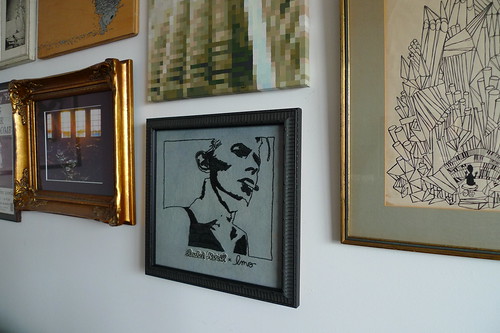
craft cabin update: a year after his gallery debut, the david bowie i sketched and embroidered is finally part of the granny cluster in our living room. i should take up my sewing again, it being the first day of fall (in weather like this, i could drink cider and pick out embroidery floss all day) and all. it's intensely satisfying to festoon the apartment with things one's made.

speaking of taking things up, i've been thinking of hosting a book chat this fall; i'm fond of and will keep going with THUNDERTOME, but it's so lovely to discuss books when one's company is, you know, on the same page. might you be interested in reading lev grossman's the magicians and meeting back here to break it down? i hadn't even heard of it until reviews of its sequel, the magician king, started popping up at the end of august; it sounds promising, though. from "the badly behaved wizards of lev grossman's the magicians," a q&a with the village voice:
VV: Reviewers have described The Magicians as an amalgamation of other books. It's Jay McInerney meets J.K. Rowling, or it's Less Than Zero plus Harry Potter. What's your own amalgamation description?

LG: You can't really leave out Rowling or C.S. Lewis, but the other main presences are Evelyn Waugh, particularly Brideshead Revisted, and Donna Tartt's The Secret History. Waugh takes young characters out of their sort of adolescent idyll and projects them into a very harsh and disorderly world—and just watches them flounder and sink. As they look for, you know, meaning and happiness and other things. God, I guess. And that's the structure of The Magicians, pretty much wholesale.

[...]

LG: I love Harry Potter, and it's a great fear of mine that The Magicians will be seen as a criticism or even an attack on Rowling. But I wanted to . . . test him. To test Harry. Or a Harry-like figure. To see what would happen if he was, say, having sex instead of snogging, or drinking real beer instead of butterbeer, if . . . his friends didn't have a Voldemort in their universe to tell them who's good and who's evil, to give them something to fight against.

VV: And what happens?

LG: Well, the story becomes less about fighting evil, using magic to fight evil, and more about trying to figure out . . . what the fuck magic is for.
could be interesting, no? i'm thinking we could plan to have the magicians under our belts (as it were) by halloween, which is both easy to remember and several weeks away; we could then meet back here around the first of november and talk wizards. and, like, waugh. what do you think?

09.20.11

THUNDERTOME II: ROUND 6

SURVIVOR: anna karenina (leo tolstoy)*
CHALLENGER: the long ships (frans g. bengtsson)

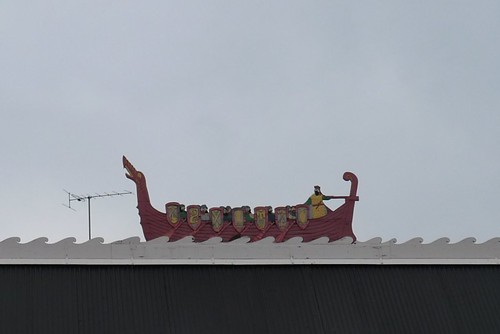
a viking boat on the roof (detail)

joe and i spent an hour in a danish bar on ingólfsstræti when we were in reykjavik in march. it was just the sort of dour nordic place you'd envision after reading a bunch of stieg larsson novels:** the carpet smelled of old lager and misanthropy, a couple of crew-cut older men were sitting by themselves and scowling at their newspapers, and the bartender seemed mortified when i asked for the house darts. it was a far cry from the tentative-but-ultimately-jolly bar scenes everywhere else in town, and it made me so sad for denmark; just think of all the dead and dying dreams that must have seeped into its gorgeous midcentury furniture.

i was leery of that fuggy danish manliness when, as i purchased michael chabon's wonder boys several months ago, amazon first tried to sell me on frans g. bengtsson's the long ships.*** what could a seventy-year-old novel about a-viking a thousand years ago (note that "viking" is both a noun and a gerund here; vikings go a-viking) have for me? chabon's gushy paris review essay introduces the long ships, and he will brook no skepticism: "[T]his novel, first published in Sweden during the Second World War, stands ready, given the chance, to bring lasting pleasure to every single human being on the face of the earth. [...] When you arrive at its bittersweet, but mostly sweet, conclusion, I trust that you will turn to your shipmate, your companion in adventure, and swear by ancient oaths, as I hereby swear to you: It is really good." well, i liked the master and commander movie back in the day, and that was a sausage party on the high seas. why not?

the long ships follows orm tostesson, a doughty young skanian son-of-a-thane who's clocked with an axe while defending the family sheep from marauding jomsvikings; he's spirited away with the livestock so that he can row in place of the man he killed and is a valued member of the crew until he's captured and enslaved by the caliph of córdoba. the long ships is full of enslavement and re-enslavement on all sides - women in particular tend to get smuggled around in barrels and dangled from the sides of ships - but the principals seem to take it in stride (as do a few of the women?), much as a taxi driver does when you cut him off for once. hauled from your ship and tossed ashore to grow limp like produce while your captors prep new shackles for you? ah, well; best to compose poetry and save your strength so that you'll be ready when the time comes to drown your overseer in boiling pitch. equal emphasis on the poetry and the pitch.****
So the Vikings were defeated, and their victors rowed ashore to examine what they had won and to bury their dead. They cleared the decks of the ship they had captured, throwing the corpses overboard, and began to rummage through its cargo, while the prisoners were led ashore and sat down on the beach, well guarded, with their arms bound. There were nine of them, all wounded. They waited for death, staring silently out to sea; bout there was no sign of Berse's ships or of their pursuers.

Toke sighed and began to mumble to himself. Then he said:

"Once, thirsty, I
Wasted good ale.
Soon shall I taste
Valhalla's mead."

Orm lay on his back, gazing up at the sky. He said:

"At home in the house
That saw me grow
Would I were seated now
Eating sour milk and bread."

But none of them was sicker at heart than Krok; for ever since the beginning of their expedition, he had regarded himself as a lucky man and as a hero, and now he had seen his luck crumble within the hour. He watched them throwing his dead followers overboard from what had been his ship, and said:

"The plowers of the sea
Earned for their toil
Misfortune and a foul
And early death."

Toke observed that this was a remarkable coincidence, that three poets should be found in such a company.

"Even if you cannot fully match my skill at composing verses," he said, "yet be of good cheer. Remember that it is granted to the poets to drink from the largest horn at the banquet of the gods."
oh, snap! predictably, the (frequent) nordic poetry slams are my favorite bits of the long ships; less predictably, perhaps, they jostle for favor with all sorts of things. i had an acute renaissance faire phase in elementary school / junior high / (cough) high school (i was wa-ay over at the wizardy end of the nerd spectrum), and it should go without saying that i enjoy an enthusiastic yuletide death match; i also enjoy viking curses ("may she toss perpetually in the whirlpool of hell among sword-blades and serpents' fangs!"), practicality ("It takes time for landlubbers to appreciate the beauty of life at sea. With this wind, though, they can vomit to windward without its blowing back into the face of the next man, and many quarrels between irritable persons will thereby be avoided."), and tolerance.
Brother Willibald bent down, picked up a large stone, and flung it with all his might.
"Love thy neighbor!" he grunted as it left his hand.
The stone struck King Sven full on the mouth with a loud smack. With a howl of agony, he crumpled on the horse's mane and slithered to the ground.
"That is what I call a good priest," said Rapp.
unlike chabon, i wouldn't argue that the long ships has something for everyone; i lent it to my friend megan, one of the most valiant readers i know, and she failed (though she strove mightily) to appreciate orm and his colleagues; she failed, in fact, to make it through the book at all. how, then, is one to know if it's worth one's while?
More years ago than I like to recall, I was a student of medieval literature at Cornell University. During my first year of graduate school I signed up for Old English, Introduction to Medieval French, Chaucer, Middle High German Literature, and the Icelandic Saga in Translation--we were serious students in those days. I learned a lot, but the Icelandic sagas completely bowled me over: Think spaghetti westerns with swords—only more thrilling. Except for the fact that it was written in the middle of the 20th century, Frans G. Bengtsson's magnificent book is essentially just such a saga, and if you love heroic literature, whether it be Njal Saga or Tolkien's Lord of the Rings or Philip Pullman's Dark Materials trilogy or Robert E. Howard's tales of Conan the Cimmerian, The Long Ships is the best end-of-summer treat you can possibly imagine.

(washington post book world columnist michael dirda, bn.com)
bearing in mind that my love for nearly all things even remotely icelandic undoubtedly clouds my judgment, i think dirda nails it. as the golden afternoons contract and it becomes necessary to snuggle beneath plaid things and take up tales of adventure, the strong-stomached among you should give orm & co a try; as david foster wallace noted in a childhood poem, they'll kill you very well.


VICTOR: you know what? i was going to say that i couldn't send anna to its maker in good conscience, but i'm feeling bloodthirsty. the long ships is the most entertaining thing i've read all year. the count is down.


imaginary reading group discussion questions

01 have you ever been to a danish bar? did it suck?

02 in happier news of danes (news of happier danes?), are you the person who told me i should listen to the raveonettes? you were so right.

03 is it granted to the poets to drink from the largest horn at the banquet of the gods?

04 if you find yourself on the nerd spectrum, where are you?

05 has fall fallen where you are?

06 what's the most entertaining book you've read this year?


*previous battle here.

**i've read one.

***the southern provinces of sweden belonged to denmark in 980-1010; while bengtsson was a swedish novelist, i lump him in with the mean old danes.

****"[Töglag] was the latest and most difficult verse-form that the Icelandic poets had invented, and indeed his poem was so artfully contrived that little could be understood of its content. Everybody, however, listened with an appearance of understanding, for any man who could not understand poetry would be regarded as a poor specimen of a warrior; and King Harald praised the poem and gave the poet a gold ring. Toke plunged his head between his hands on the table and sighed disconsolately; this, he muttered, was real poetry, and he could see that he would never be able to succeed in writing the sort of verse that won gold rings."

09.11.11

manhattan challenge II: fin

Still, there is a need, now and always, for sharply felt local intimacies. I stood by the corner and watched the woman's dilemma. It could have been grief, it could have been grace, or even a dark, perverse sense of humor. She held the forkful of cake for a very long time. As if it were waiting to speak to her, to tell her what to do. Finally, she ate a bite of it. She sat looking into the distance. She pulled her lips along the silver tines to catch whatever chocolate remained there, then turned the fork upside down, ran her tongue along it. It was the gesture of someone whose body was in one place, her mind in another. She pierced the cake again.

The darkness rose over the Upper East Side. The woman finished her dessert. She didn't pinch the crumbs. She placed the fork across the plate. She paid. She left. She didn't look at anyone as she turned the corner toward Lexington Avenue, but she still returns to me after all this time, one corner after another, a full decade now.

My mind is decorated with splinters. Ten years of enmity and loss. Bush, Cheney, Blackwater, Halliburton, Guantánamo, Abu Ghraib, bin Laden. Another long series of wars, another short distance travelled. We do not necessarily need anniversaries when there are things we cannot forget. Yet I also recall this simple, sensual moment. I still have no idea - after a decade of wondering - whether I am furious at the woman and the way she ate chocolate cake, or whether it was one of the most audacious acts of grief I've seen in a long, long time.

(colum mccann in the new yorker, 09.12.11)
09.06.11: the dirty dozen {wrought iron in philadelphia}

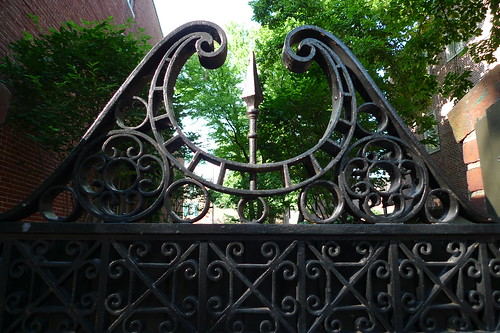
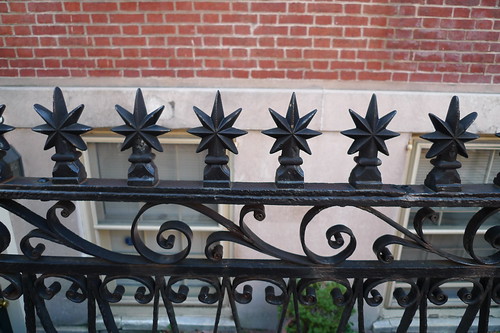
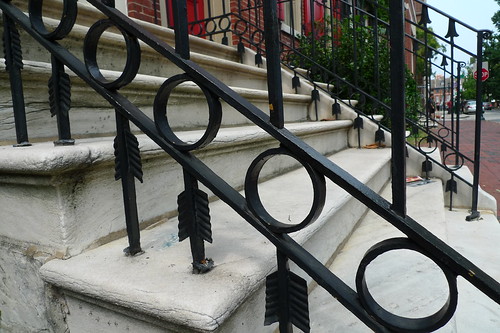
do not make the mistake of assuming that a safari in search of immobile architectural details is less hazardous than a safari in search of moving creatures; indeed, one assumes at one's peril that architectural details cannot move.

01 wrought iron 02

wrought iron 03 wrought iron 04

wrought iron 05 wrought iron 06

wrought iron 07 wrought iron 08

wrought iron 09 wrought iron 10

wrought iron 11 wrought iron 12